Thursday, 17 May 2018

Patrick Ness: The Knife of Never Letting Go (2008)

    Imagine you can hear everything the town of men say about you. And they can hear everything you think. Imagine you don't fit into their plans. Todd Hewitt is just one month away from the birthday that will make him a man. But his town has been keeping secrets from him. Secrets that are going to force him to run (Goodreads).

    Yeah, it's a little hard to get into, a little difficult to adjust to the narrating voice, but at the same time, the simplistic diction strikes hard into the heart of the reader, and the repetitive way that Ness writes is only repetitive in the sense that his writing strikes an emotional blow every time. This repetition seems to bleed into the story structure, however, and some scenes feel a bit too much like earlier ones. In addition to the writing, Ness also develops wonderful characters, with the conflicted Todd and the intelligent Viola. His world building is also executed decently, although the setting itself isn't incredibly unique. The history and lore of the world, however, is perfectly written, complete with a sadistic cast of villains that relentlessly pursue our heroes, leading to a seemingly hopeless main story, which, with Ness' short, poignant style, leads readers to also long for relief with the protagonists. The main intense scenes are written with such an enthralling simplicity that readers are left with an unfamiliar sense of "hold up, did that just happen?" that they wouldn't have gotten with a scene that is extremely detailed. It's a bold approach, but Ness pulls it off. And that's without mentioning the cool, overwhelming font changes with the Noise. Some heartbreaking... erm... departures add to the overpowering sense of hopelessness woven throughout the tale, and the recurring themes of truth and coming-of-age are also developed well. Wrap it up with one heck of a cliffhanger, and we're left with an incredible series opener. 8.6/10

Sunday, 1 April 2018

Ransom Riggs: Miss Peregrine's Home for Peculiar Children (2011)

    As our story opens, a horrific family tragedy sets sixteen-year-old Jacob journeying to a remote island off the coast of Wales, where he discovers the crumbling ruins of Miss Peregrine's Home for Peculiar Children (Goodreads).

    A very unique concept with found photography is fleshed out beautifully in this introductory novel to Riggs' trilogy. The first half of the novel is particularly excellent in establishing characters and conflict, and although the protagonist is a bit of a brat at times, his multidimensional character gives wonderful substance to the plot around him. The supporting cast has its moments, but are slightly flat at times (other than the protagonist's father, who has great depth, and almost needed more plot dedicated to his internal conflict). After the first half, the book slips slightly into the YA novel trap of typical good versus evil tropes and a weak romance. The main villains aren't too interesting, but Riggs' use of descriptive language and red herrings overwhelms the novel's few shortcomings, most of which are hopefully redeemed in the last two parts of the trilogy. All in all, a great world-building novel that combines intriguing images with an equally compelling story. 8.0/10

Saturday, 31 March 2018

Marcus Sedgwick: The Ghosts of Heaven (2014)

    A cleverly interlinked novel written in four parts by PRINTZ AWARD-winning author, Marcus Sedgwick, about survival and discovery, and about the effect of the spiral, a symbol that has no end, on all our lives (Goodreads).

    Sedgwick creates a cool concept, with the four unique stories and compelling characters, but for all the anticipation of a mind-blowing novel, it doesn't really live up to the hype. Sure, it's mildly thought-provoking, but more like a nice collection of short stories slightly tied together, similar to Bradbury's Illustrated Man. In addition to stretching its connectivity, the possibility of reading the stories in different order is somewhat useless and doesn't really add anything (there is also the matter of there being an obvious conclusion in the final installment, tying the four together, rendering this concept of reading in any order somewhat useless). Other than the wasted potential, Sedgwick successfully builds great suspense in each story, and the use of verse in the opening is also a creative way to narrate, and what is very impressive about that is the way it stays compelling. The third tale is also quite intriguing and original, but the second and fourth, while still interesting, aren't quite up to par with the originality of the others, even though the last two are wonderfully emotional and profound. 6.9/10

Friday, 2 March 2018

Kevin Sands: The Assassin's Curse (2017)

    Wherever Christopher Rowe goes, adventure—and murder—follows. Even a chance to meet King Charles ends in a brush with an assassin. All that’s recovered from the killer is a coded message with an ominous sign-off: more attempts are coming (Goodreads).

     It was going to be difficult to follow up on the fantastic second book, but this third novel in Sands' historical mystery is really quite satisfying on many levels. A new setting is given to readers, this time exploring Paris instead of London, and the winding streets and secrets of the city give a good backdrop for the story. Christopher is, once again, very compelling, as are his two sidekicks, although it's becoming a bit Golden Trio, if you know what I mean. Tom especially branches out in this one, and provides good comic relief throughout. Sally, too, is fleshed out a bit more as well, which is great considering her character was a bit bland in the second book. Sands once again has readers on their toes throughout, giving several candidates for the main antagonist, but still giving a surprising twist at the end. The villains are adequately, well, villainous, but they are not developed quite as much as would be ideal, although the ending message could prove otherwise in the future. 8.1/10

Monday, 12 February 2018

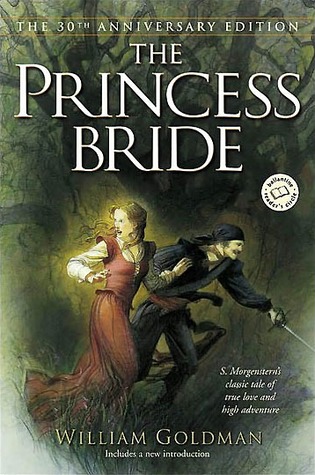
William Goldman: The Princess Bride (1973)

    What happens when the most beautiful girl in the world marries the handsomest prince of all time and he turns out to be...well...a lot less than the man of her dreams (Goodreads)?

Fantastic characters certainly take the spotlight in Goldman's novel, with the Spaniard and the giant stealing the show, with their unusual friendship, from the two main protagonists themselves. Indeed, the two lovers are slightly less dynamic than ideal, as they have much less of a compelling background than either Inigo or Fezzik. However, all characters throughout (Goldman himself included) strut their stuff as an entertaining and humorous plot takes place. Goldman's writing (or perhaps it is S. Morgenstern's) moves so quickly, and readers are thrust from one exciting plot point to another, with Goldman's amusing commentary providing a refreshing pit stop in the midst of fast-paced storytelling (sometimes so fast-paced that one may have to track back a few sentences). The ending is somewhat satisfactory, but readers are still left hunting for a continuation of the tale (part of which is satisfied in the annals of the 30th anniversary edition). 8.4/10

Tuesday, 6 February 2018

Stephen R. Lawhead: The Warlords of Nin (1983)

    An urgent message summons Quentin to Castle Askelon. The king, who is dying, wishes to name the brave young man his successor. But first, he sends him on an unfathomable mission (Goodreads).

As verbose and dense as it is, Lawhead's second advancement into universe-building is, well, alright. The dialogue is dry and stretched out, but what action there is is well described and somewhat entertaining. A select few scenes are particularly well done, but the rest of the novel is so extremely over-described that these scenes are almost not worth it. Similar to the first installment, the character development is unrealistic and the entire plot, almost every aspect, is highly anticipated and, yes, cliche. Lawhead obviously tries to keep pace with other, more renowned world-builders such as Tolkien and Lewis, but his attempts fall rather flat in nearly every area. The main antagonist is once again extinguished extremely weakly, after having no interactions with the protagonists. The one main addition to the protagonist's side completely vanishes after only a short time in the plot, while the climax is one of least suspense, as the very element of salvation for the seemingly doomed heroes is introduced before they are even at their most underdog-like status, therefore rendering the hopelessness that is woven throughout the novel (which might have been a good element otherwise) completely useless. Lawhead switches between points of view rather smoothly, but scenes that don't really lead to anything and almost no plot twists make the novel similar to a flat soda. 6.6/10

Friday, 1 December 2017

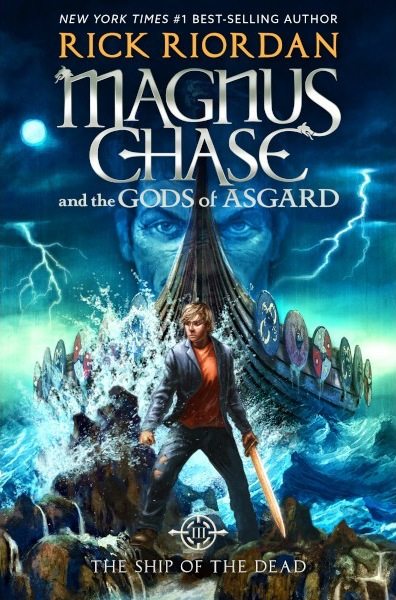
Rick Riordan: The Ship of the Dead (2017)

    Magnus and his crew must sail to the farthest borders of Jotunheim and Niflheim in pursuit of Asgard's greatest threat. Will they succeed in their perilous journey, or is Ragnarok lurking on the horizon? (Goodreads).

    Look, Riordan writes an entertaining novel. I won't deny that. If he wrote entertaining novels with some variety, I would be really on board. YET AGAIN, we are given a predictable and overused plot, this time Riordan using his 'motley crew on board a magic ship' card that he has used before. To round it all off, the Argo III-I mean, the Big Banana-has a shapeshifter, a blonde guy, and someone who doesn't understand modern cultures. All of whom, I might add, are far more interesting than Magnus himself, making me wish that it was written from their perspective instead. There is an absolutely fantastic scene in Hearthstone's story that almost redeemed the book, but unfortunately is a small part in building up to a, frankly, cheesy climax. Maybe Percy could have redeemed it, I don't know. But whatever the case, his involvement in the plot was pointless, to say the least. To top off this cake of cliches and dull narration, there is the LITERAL CHOCOLATE SYRUP of a stupid romance subplot. Not because one character is gender-fluid, mind, but because it is stupid. 5.7/10